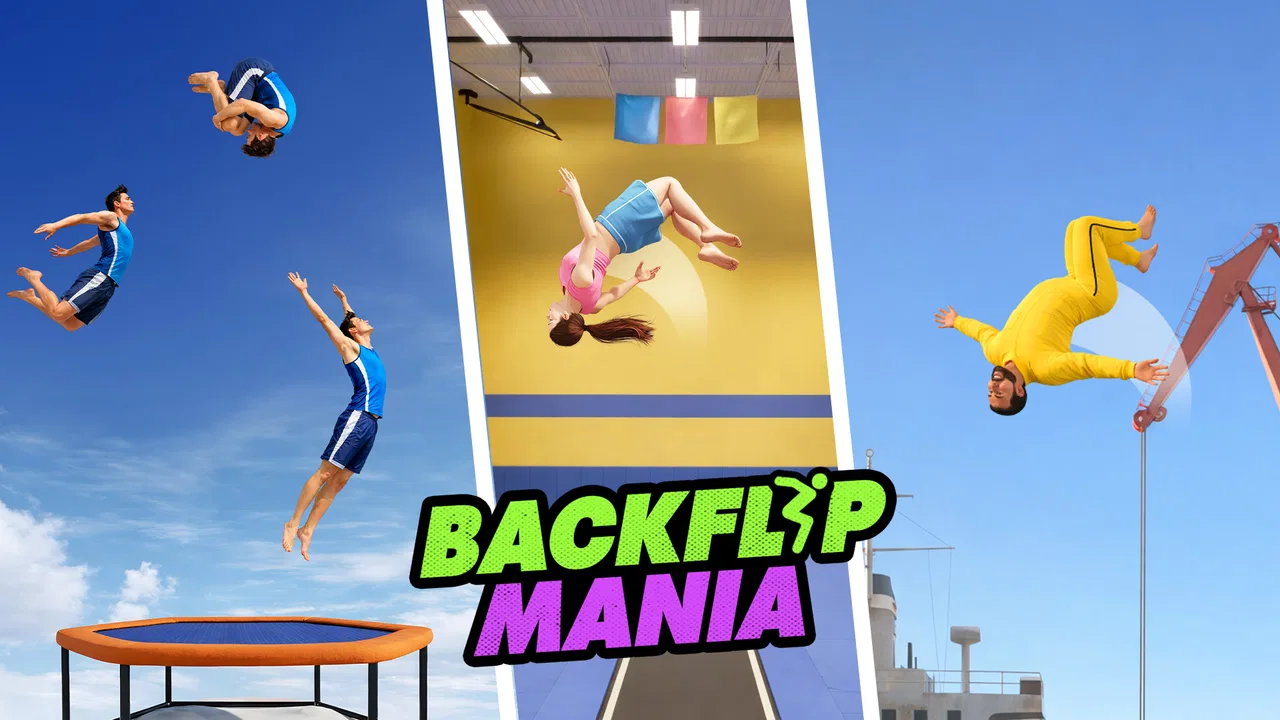
Backflip Mania
- 4.6
- Rating
- 100.00K
- Installs
- Free
- Price

 Analysis by App-foxy
Backflip Mania is the kind of sports game I open when I want a quick challenge rather than a long, complicated session. Its focus is simple to understand: control a character through backflips, judge the timing of each jump, and try to finish a landing without turning a promising attempt into a messy crash. After spending time with it, I found that the appeal comes less from variety in controls and more from the small difference between an almost-correct rotation and a clean landing.
That simplicity makes it approachable, but it also means the game depends heavily on how much you enjoy repeating a movement until your timing improves. It is free to play, carries an Everyone age rating, and comes from Wayfu Game Studio. The current version is 1.26, and the game has already passed 100K+ installs, which gives it a useful level of visibility without making it feel like an enormous mainstream sports franchise.
How the jumping feels in ordinary play
The first thing I noticed is that Backflip Mania is built around short bursts of concentration. You are not managing a full team, learning a large rulebook, or planning a season. You are watching the jump, reacting to the rotation, and trying to make the landing line up. That creates a fast rhythm: attempt, mistake, adjust, and try again.
You May Also Like

 Blood Strike: 2.5 Anniversary
Blood Strike’s Loadouts Turn Every Drop Into a Tactical Gamble
A close look at Blood Strike’s custom loadouts: how fast access to signature weapons reshapes its battle royale rhythm, rewards preparation, and narrows the gap between fights.

 Pandora - Music & Podcasts
Pandora’s Music Is Easy to Start, but Harder to Recover
Pandora’s strength is its low-effort path from a seed to a station. Its weak spot is how much confidence it asks you to place in connection, setup, and quiet recovery.

 8 Ball Pool
 Is Built on Rivalries, Rematches, and Routine
A close look at the rivalries, rematches, shared routines, and unanswered safety questions that turn a quick pool match into a persistent mobile community.

 Samsung Music
’s Quiet Strength Is Playing What You Already Own
Its reach comes less from spectacle than from dependable access to a personal library. That simplicity is both the app’s strongest retention engine and its ceiling.

 AccuWeather: Weather Radar
AccuWeather Review: A Quick, Clear Forecast for Everyday Decisions
For everyday plans, the best forecast is the one you can understand quickly. AccuWeather makes rain timing, radar, and local conditions easy to act on, with a few trade-offs.

 Hill Climb Racing
Why Hill Climb Racing Still Turns Crashes Into One More Run
A tiny car, a bumpy hill and one more upgrade: Hill Climb Racing keeps resurfacing because its simple chaos makes every near-miss feel personal.
More From Our News Desk



Perceived speed is important here. The action feels quick because the meaningful decision arrives during a brief jump, but the game is not difficult to understand at the start. I could usually identify what went wrong after an unsuccessful attempt: I had committed too early, failed to correct the rotation, or treated a difficult landing as if it were a routine one. That clarity is a strength because failure feels connected to my input instead of completely random.
The game’s worlds help keep the movement from feeling like one repeated screen. Different environments give the jumps a changing visual context, even though the central task remains the same. I liked that the setting could make a familiar maneuver feel slightly less automatic. A route that looked comfortable in one world could require more attention in another simply because I was no longer relying on the same visual rhythm.
For a casual player, the best approach is to treat the early attempts as calibration rather than as a test of reflexes. I found it more useful to watch the character’s rotation and landing position than to rush through every input. Once I stopped trying to force a perfect result immediately, the controls became easier to read. This is one of the game’s less obvious lessons: consistent timing matters more than frantic tapping.
That also explains who will enjoy it most. If you like compact arcade challenges where improvement comes from learning a repeatable motion, this is a comfortable fit. If you prefer sports games with realistic rules, detailed athlete development, or head-to-head competition, the experience may feel too narrow. It is closer to a focused stunt challenge than to a complete simulation of gymnastics or extreme sports.
Why short sessions work well
I can imagine using it during a commute, while waiting for food, or between two larger tasks. A single attempt does not demand the commitment of a full match, and the basic objective is immediately visible. That makes the game easy to pick up after a few days away instead of requiring a long refresher.
There is also a useful recovery habit for difficult sections. Rather than replaying the same jump with exactly the same timing, I would make one deliberate adjustment at a time. Changing the release moment, then changing the correction, gives a clearer sense of what the obstacle expects. This is more effective than treating every failed landing as proof that the level is unfair.
On the other hand, short-session design can become repetitive for players who need constant novelty. The worlds add variety, but the core backflip-and-land loop remains the center of everything. I would not choose it as my only mobile game if I wanted a broad sports package. I would choose it as a compact skill game that rewards patience.
What happens during heavier play
The most demanding moments are not necessarily long sessions. They are the stretches where several attempts go wrong and I start making rushed corrections. That is when the game feels most intense, because a small loss of concentration can turn a manageable sequence into a string of failed landings.
In those moments, the practical challenge is maintaining a stable rhythm. I found that playing while distracted made the controls feel less forgiving, especially when I was trying to watch several elements at once: the character’s movement, the shape of the next jump, and the moment when a landing needed to be corrected. The game is easy to start, but more exact play asks for attention.
A useful everyday scenario is a player using it as a five-minute reset after work or study. I would recommend setting a small personal target, such as improving one troublesome sequence, rather than chasing a perfect run every time. That keeps a difficult session from becoming frustrating and turns repetition into a measurable practice routine.
Another practical tip is to pause mentally after a failed attempt, even if the game lets you restart quickly. Before trying again, I would identify the specific problem: was the rotation too early, was the landing approached at the wrong angle, or did I simply react too late? That tiny review makes the next attempt purposeful. Without it, repeated retries can feel like noise.
The trade-off is that the game’s strongest quality and its biggest limitation are closely related. Because the controls are centered on a small set of actions, improvement can feel satisfying when I understand the timing. But once I have seen enough of the same pattern, the experience may lose momentum if I am not personally motivated by mastery. Players who like score chasing and precision will probably stay longer than players who want a story or a large collection of unrelated activities.
Resource expectations and comfort
I would place Backflip Mania in the lighter end of mobile sports gaming based on its focused design. It does not present itself as a large simulation with a broad management layer, so it is easier to approach when I want a quick game rather than an extended production. Still, any game with repeated movement and changing worlds can feel more demanding during active play than a static puzzle or simple card game.
For that reason, I would close other demanding apps before a long practice session on an older phone. That is not because the game is known to be unusually heavy; it is simply a sensible way to reduce distractions and keep the device focused on the game. I would also avoid judging the experience during a moment when the phone is already busy with downloads, updates, or many open apps.
Battery expectations should be kept practical. A few short attempts are a different use case from playing continuously for a long stretch. If I were trying to improve a difficult world, I would take breaks rather than assume that more uninterrupted time automatically means better progress. Breaks help with concentration, and they also make the game fit more naturally into everyday mobile use.
The minimum operating-system requirement is Android 7.0, so the game is not limited to only recent Android devices. That is useful for readers with older compatible phones, although the age of a device alone does not tell me how comfortable the game will feel. Screen responsiveness, available free space, and the general condition of the phone can matter just as much during a timing-based game.
Stability, interruptions, and getting back into play
Reliability matters more in a reflex game than in a slow reading app because a small interruption can ruin an attempt. My preferred way to use Backflip Mania is to play when I can give it a few uninterrupted minutes. That reduces the chance that a message, call, or sudden change of attention will be mistaken for a control problem.
The recovery experience is strongest when I treat a failed landing as a normal part of the loop. The game’s design encourages returning to another attempt instead of requiring a long setup before every jump. That makes mistakes less costly emotionally and keeps the pace moving. I appreciate this because a stunt game becomes tiring quickly if every failure sends me through several menus.
There is still a limitation for anyone expecting the dependability of a console-style sports title. A mobile game played in short bursts is naturally more vulnerable to interruptions from the phone itself. I would not start a serious practice run while navigating, attending a meeting, or doing anything that requires immediate attention. For relaxed play, that is a reasonable boundary; for competitive concentration, it is worth remembering.
The game has an average rating of 4.6 from around 705 ratings, with 18 written reviews shown alongside it. I read that as a positive sign of early player satisfaction, but not as a guarantee that every device or play style will feel identical. A rating can tell me that the central idea is connecting with players; it cannot replace trying the controls personally.
Wayfu Game Studio has kept the concept easy to identify, which helps with recovery after time away. I do not need to relearn a complicated roster or remember a large set of systems before playing again. My return routine would be simple: make a few low-pressure attempts, observe the timing, and only then return to the section that previously caused trouble.
Device fit, spending, and the right audience
Because the game is free, the initial decision is easy. I can install it without paying upfront and decide whether the movement feels satisfying before spending anything. That is a better arrangement for this kind of title than committing to a premium price before knowing whether I enjoy repeated stunt attempts.
There are in-app purchases ranging from $1.99 to $6.49 per item. I would treat those as optional spending rather than part of the basic reason to try the game. Anyone who prefers completely uninterrupted free play should look carefully at the purchase prompts and set a personal limit before getting invested. A free download can still become expensive if I buy impulsively during a frustrating run.
For families, the Everyone rating makes the game easier to consider for a broad age range. Even so, younger players may need help understanding that repeated failures are part of the challenge rather than a sign that something is broken. Adults who want a calm, low-pressure game should also know that the action can become tense when a carefully prepared jump fails at the final landing.
Compared with a full sports simulation, Backflip Mania is much easier to learn and far less concerned with realism, statistics, or long-term team management. Compared with a general arcade collection, it offers a more focused skill loop and gives timing a larger role. Compared with a physics sandbox, it feels more directed: I am trying to execute a stunt successfully rather than freely experimenting with every possible movement.
That comparison makes the choice fairly clear. Choose this game if you want a compact backflip challenge with changing worlds and a straightforward practice loop. Choose a different sports game if you need leagues, realistic match structure, multiplayer competition, or deep customization. Choose a puzzle or idle game instead if your main priority is something that can be played with almost no concentration.
One device-related trade-off is screen size. A larger display can make movement easier to follow, while a smaller phone may feel more cramped during quick corrections. I would not reject the game solely because of a compact screen, but I would give myself a few attempts before deciding whether the controls feel comfortable. Touch precision matters more here than it would in a turn-based game.
A practical routine for improving without frustration
My preferred routine is to divide play into three phases. First, I make a few relaxed attempts to understand the current world. Next, I focus on one landing that repeatedly causes trouble. Finally, I stop after a clear improvement instead of continuing until every attempt becomes hurried. This approach turns a short mobile game into a small, manageable practice session.
I would also recommend changing only one variable at a time. If I alter both the timing and the correction after every failure, I cannot tell which adjustment helped. Keeping the change narrow makes the game more readable and exposes whether the problem is my reaction or the route itself. That is a simple technique, but it adds more value than blindly restarting.
Players should skip it if repetition quickly feels like work. The game’s appeal depends on accepting that the same basic action may need to be attempted many times before it feels natural. It is also not the right choice for someone seeking a realistic representation of a professional sport. The stunt theme is the point, and the focused design leaves little room for the broader systems those players may expect.
My performance verdict after repeated sessions
Backflip Mania works best as a focused, free sports game for short sessions and gradual improvement. I like its clear objective, its quick return to another attempt, and the way different worlds keep the central movement from feeling completely static. The game does not need a large feature list to be enjoyable; its satisfaction comes from turning an awkward landing into a clean one.
Its limitations are equally clear. The backflip-focused loop may become repetitive, and players who want a complete sports simulation will find it too narrow. Heavy play also depends on concentration, so it is not ideal when the phone is constantly interrupting or when I want something passive. The optional purchases, priced from $1.99 to $6.49 per item, are another reason to decide in advance how much I am comfortable spending.
The game was released on Feb 28, 2026, and its current version is 1.26. Those details make it a relatively recent option for readers looking for a small Android sports challenge, while the Android 7.0 minimum keeps it accessible to a range of compatible devices. I would still judge the experience by actual touch comfort and attention demands rather than by the operating-system requirement alone.
Overall, I would recommend Backflip Mania to anyone who enjoys timing-based arcade games and wants a free way to practice a single satisfying skill. I would especially suggest it for short breaks, casual personal challenges, and players who like learning through repetition. I would pass on it if I needed multiplayer, career progression, realistic sport rules, or constant variety.
My final advice is to give it a focused trial rather than making a decision after one failed jump. Play long enough to understand the timing, try the same difficult landing with one deliberate adjustment, and notice whether improvement feels rewarding to you. If that small cycle of attempt, correction, and recovery is enjoyable, Backflip Mania has enough charm to earn a place among your quick-play games. If it feels repetitive before the controls become satisfying, another sports title with broader systems will probably be a better match.
FAQs for Backflip Mania
01What is Backflip Mania, and how does it work?
Backflip Mania is an engaging mobile game available on Android and iOS that challenges players to perform acrobatic flips and tricks. The game offers multiple levels, each with increasing difficulty, where you control a character to execute backflips and other maneuvers. The objective is to land successfully without crashing, earning points and unlocking new levels and features.
02Is Backflip Mania free to play, or does it require in-game purchases?
Backflip Mania is free to download and play, offering a range of levels and challenges at no cost. However, it includes in-app purchases that allow players to unlock additional levels, characters, or special items. These purchases enhance the gameplay experience but are entirely optional for those who prefer to enjoy the game without spending money.
03What are the main features of Backflip Mania?
Backflip Mania features a variety of levels with stunning graphics and realistic physics that make the gameplay both challenging and enjoyable. It includes customizable characters, different environments, and a leaderboard system to compete with friends. The game’s intuitive controls make it accessible for players of all ages, enhancing its replay value.
04Does Backflip Mania require an internet connection to play?
Backflip Mania can be played offline, making it convenient for users who want to enjoy the game without needing a constant internet connection. However, certain features, such as updating the leaderboard or accessing in-app purchases, do require internet access. This flexibility allows players to enjoy the game anytime and anywhere.
05What devices are compatible with Backflip Mania?
Backflip Mania is compatible with a wide range of Android and iOS devices. It requires Android version 5.0 or higher and iOS 11.0 or later. The game is optimized for both smartphones and tablets, ensuring a smooth and enjoyable experience across different screen sizes. Check your device's specifications to ensure optimal performance.
Pros
- Intuitive controls make gameplay smooth.
- Variety of levels keeps it engaging.
- Stunning graphics enhance visual appeal.
- Challenging stunts for skill improvement.
- Regular updates with new content.
Cons
- In-app purchases can be pricey.
- Occasional ads disrupt gameplay.
- Limited character customization.
- Requires internet for full features.
- Some levels can feel repetitive.

Backflip Mania
Gallery